April 9, 2026
How to wrap cords and chargers professionally
Cords and chargers seem harmless until you unpack and discover a knot that looks like it survived a sailing expedition. Tangled cables waste time, stress your patience, and quietly damage the wires inside. Anyone who has replaced a phone charger or laptop cable sooner than expected has felt this frustration. The way cords are wrapped during a move has a direct impact on how long they last, how safe they remain electrically, and how easy your setup feels when you arrive in your new space.
The scale of the issue is larger than most people realize. Consumer electronics reports estimate that the average household owns more than twenty powered devices when you include phones, tablets, laptops, printers, routers, speakers, lamps, kitchen appliances, and smart home accessories. Each device usually comes with at least one power cable and sometimes multiple adapters. That means a typical move may involve dozens of cords. When they are tossed loosely into a box, they behave like springs under vibration and quickly twist into tight coils and knots.
There is also a durability angle. Electrical engineering studies on cable fatigue show that repeated sharp bending and twisting weakens copper conductors and insulation layers over time. Micro fractures develop internally long before the cable fails visibly. Consumer product testing organizations have found that poorly handled cables often fail months earlier than properly stored ones due to internal conductor stress. Wrapping cables with controlled curves rather than tight bends reduces that fatigue.
Professional movers and audiovisual technicians use simple principles grounded in physics and material science rather than guesswork. The first principle is respecting bend radius. Every cable has a minimum safe curve radius where internal stress remains low. When a cable is bent sharply, the outer insulation stretches while the inner conductor compresses. Over time this imbalance creates weak points that lead to intermittent charging, heat buildup, and eventual failure. A smooth loop roughly the size of a dinner plate distributes stress evenly and preserves conductor integrity.
The second principle is eliminating twist memory. Many people naturally twist a cable while wrapping it around their hand. This creates internal torsion that stores energy in the cable. When released, that energy causes the cable to coil back on itself and tangle. Mechanical testing shows that torsional stress accelerates insulation wear and increases knot formation during vibration. Professional wrapping keeps the cable flat and untwisted as it forms loops.
One widely used technique in professional audio and film crews is the over under method. It alternates the direction of each loop so internal twist cancels itself out. While this technique requires a bit of practice, it dramatically reduces tangling and allows cables to lay flat when unwrapped. Broadcast engineering teams rely on this approach because tangled cables waste valuable setup time and increase damage risk in high pressure environments.
Length management matters as well. Long cables should not be wrapped tightly into small bundles because that increases bend stress. Short cables benefit from slightly smaller loops but still need smooth curvature. Packaging engineering research shows that tighter radius bends concentrate stress and reduce fatigue life compared with broader curves.
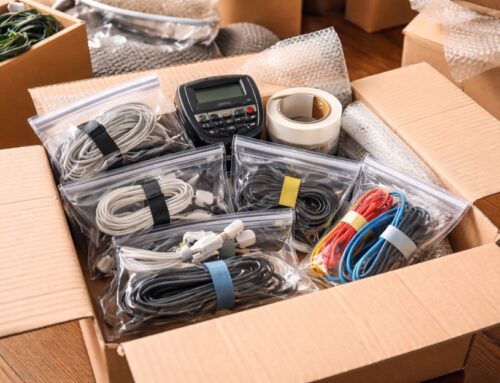
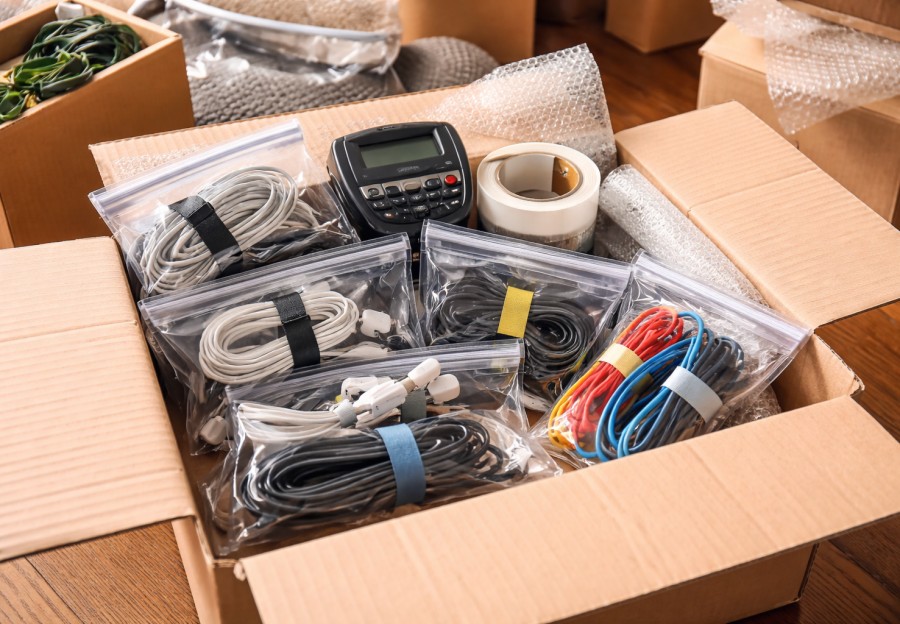
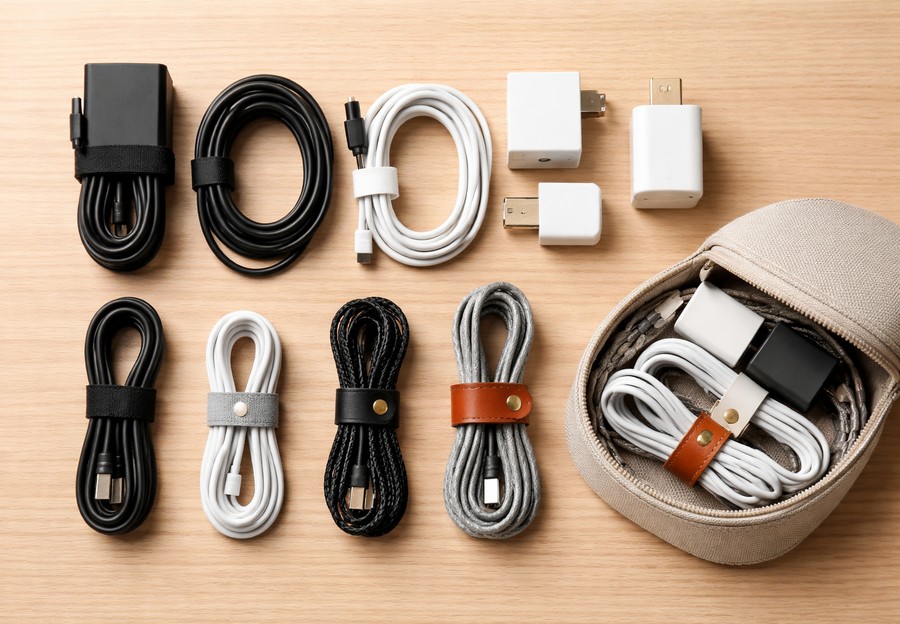
Securing the wrapped cable correctly prevents re tangling. Soft hook and loop straps or reusable silicone ties work better than hard rubber bands or tape. Rubber bands degrade over time, snap unexpectedly, and can bite into insulation. Tape leaves residue that attracts dust and grit, which increases abrasion. Material wear studies show that adhesive residue accelerates surface degradation and attracts particulate contamination.
Labeling saves significant time later. With many chargers looking nearly identical, guessing which cable belongs to which device wastes setup time and increases the chance of plugging in the wrong power supply. Consumer electronics safety data shows that using incorrect adapters can damage devices or shorten battery lifespan due to voltage mismatch. Simple labels or color tags reduce this risk and speed up reassembly.
Another professional habit is separating power cables from data cables. USB, HDMI, Ethernet, and audio cables have different shielding and connector sensitivity than heavy power cords. Mixing them tightly can cause connector abrasion and pin bending during transit vibration. Packaging vibration studies show that mixed density items inside a container increase collision damage risk compared with grouped similar items.
Adapters and power bricks deserve special attention. These components concentrate weight in small areas and can crush thinner cables if packed together loosely. Placing each adapter with its own wrapped cable prevents strain at the connector junction. Connector fatigue is one of the most common failure points according to electronics repair statistics.
Heat sensitivity also matters. Vehicle interior temperature studies show that closed trucks can exceed outdoor temperatures by more than 20 degrees Celsius in direct sun. Elevated heat softens plastic insulation and increases deformation under pressure. Cables packed under heavy items or tightly compressed during heat exposure are more likely to develop permanent kinks. Keeping cables loosely coiled and protected from compression reduces this risk.
Moisture is another hidden threat. Condensation can form when warm air cools inside sealed boxes. While most cables tolerate brief moisture exposure, prolonged dampness can corrode connector contacts and promote mold on fabric wrapped cords. Electronics reliability research shows that corrosion at contact points increases resistance and heat generation over time. Dry packing materials and breathable organization help mitigate this.
Transport vibration magnifies small mistakes. Packaging lab testing shows that vibration causes loosely packed cords to migrate and knot even when initially neat. Securing each cable individually prevents the kinetic energy of vibration from turning organized bundles into tangled nests.
Storage orientation inside the box influences outcome. Stacking wrapped cords flat rather than vertically reduces gravitational compression and shifting. Layering them with light padding prevents movement and keeps connectors from rubbing.
There is also a safety angle. Damaged insulation increases shock risk and fire hazard. Electrical safety agencies report that frayed or internally compromised cords contribute to a meaningful share of household electrical incidents. Proper handling extends cable life and reduces safety risk.
From a cost perspective, replacing chargers adds up quickly. Consumer pricing data shows that branded laptop chargers, phone fast chargers, and specialty adapters often cost significantly more than generic replacements. Replacing multiple cables after a move becomes an unnecessary expense that could have been avoided with simple wrapping discipline.
Environmental impact matters too. Electronic waste continues to grow globally, with millions of tons discarded annually according to international environmental agencies. Extending the life of cables reduces landfill burden and manufacturing demand. Small habits scale into meaningful environmental benefit over time.
Professional movers also think about workflow. When cables are wrapped, labeled, and grouped by room or device, unpacking becomes faster and calmer. Time management studies show that reducing small friction points improves overall task satisfaction and lowers stress during transitions. Instead of hunting for the right charger while exhausted, you plug in and move on.
Cords associated with critical devices such as internet routers, work computers, medical equipment, and security systems deserve priority packing. Keeping those cables in a clearly marked essentials container ensures fast setup. Connectivity downtime studies show that even short internet outages impact work productivity and stress levels significantly in remote work households.
Photographing complex setups before disconnecting helps later as well. Visual memory supports accurate reconnection of multi cable systems such as home theaters, desktop workstations, and gaming rigs. Cognitive research shows that visual references outperform written notes for spatial reconnection tasks.
Avoid coiling cords tightly around adapters or device bodies. This places constant strain at the connector junction, which is the most failure prone zone according to repair technicians. Leave a gentle curve where the cable exits the adapter or device so strain relief can function properly.
For very long or heavy duty cables, consider figure eight looping rather than circular coils. This distributes stress more evenly across the cable length and reduces memory effect. Industrial cable handling guidelines often recommend figure eight storage for extension cords used on job sites to extend lifespan.
If cables must be stored long term during a move or renovation, periodic inspection helps. Look for kinks, flattened sections, exposed insulation, or loose connector housings. Early replacement of compromised cables prevents device damage and safety risk.
Children and pets introduce additional risk after a move. Tangled cords on the floor become trip hazards and chewing targets. Organized cable management improves home safety and reduces accidental damage.
Professional wrapping also improves aesthetics and organization once you settle in. A clean cable system supports airflow around electronics and reduces dust accumulation. Electronics cooling studies show that dust buildup reduces thermal efficiency and shortens component lifespan.
There is also a psychological benefit. Order reduces cognitive load. Behavioral research shows that organized environments improve perceived control and reduce stress during complex transitions like moving. Small wins such as neatly wrapped cables contribute to overall calm during setup.
Time investment is minimal. Wrapping a cable properly takes seconds once the habit forms. Compared with the hours spent untangling knots, replacing damaged chargers, or troubleshooting intermittent connections, this is an efficient trade.
Consistency matters more than perfection. Choose one method and apply it to every cable. Consistency reduces mental friction and speeds packing. Team coordination studies show that standardized methods improve efficiency and reduce error rates.
If multiple people are packing, agree on the wrapping standard so all cables behave the same way during unpacking. Mixed wrapping styles increase confusion and tangling risk.
In the end, wrapping cords and chargers professionally comes down to respecting material limits, preventing twist, controlling vibration movement, and preserving connector health. Smooth loops protect internal conductors. Alternating loop direction reduces memory. Soft ties prevent abrasion. Labeling prevents misuse. Separation prevents collision damage. Thoughtful placement prevents compression. Climate awareness protects insulation. Visual references support fast setup.
Cables may be small, but they connect everything that makes modern life work. Treating them with the same care you give furniture and electronics protects performance, safety, and your sanity. When you plug in on the first night and everything works without a single knot or dead charger, you will feel the quiet payoff of a professional approach.